

EIMA 2026 in five minutes: smarter machines, new energy and the question that matters most
Picture BolognaFiere in November. Hall after hall of tractors, implements, sensors and screens. Outside, in the REAL demonstration area, robots and highly automated machines go through their paces. Every visitor walks away with a different favorite. But the question worth taking home is a simple one: how much of all this technology will turn into useful work in your fields?
What is EIMA?
EIMA International is one of the world’s leading exhibitions of agricultural and gardening machinery. Organized by FederUnacoma, the Italian federation of agricultural machinery manufacturers, it takes place every two years at BolognaFiere in Bologna, Italy. The 47th edition ran from 10 to 14 November 2026. Across 14 product sectors and dedicated showcases for digital technology, energy, components, irrigation and green-area care, it brings together tractors, implements and components from all over the world, with outdoor areas where machines can be seen at work. For farmers, contractors and dealers, it is one of the key places to see where farm mechanization is heading.
Record crowds
EIMA 2026 broke its own record: 370,000 visits, up 7 percent on 2024. Around 68,000 visitors came from 150 countries, and about 1,800 exhibitors filled the halls, 690 of them from abroad.
Visitors were not chasing novelty for its own sake. They were hunting for ways to get more out of every hour, every liter and every hectare.
Machines that think ahead
If one idea ran through the EIMA Technical Innovations contest, it was this: the best machine solves a problem before it stops the job. The contest recognized 19 Technical Innovations and 35 Technical Evolutions this year. Here is what caught our eye.
- Power on demand. A large baler reads the incoming crop with sensors and machine learning, then smooths out load peaks with a controlled clutch.
- Smarter fieldwork. A plow adjusts its working depth from prescription maps, and a seeder keeps ground pressure even across every row unit.
- An easier day in the cab. Cab and front-axle suspension, ISOBUS implement management and even a joystick with vibration feedback and a heated grip.
- Safety that watches out for people. An AI camera on a mulcher is designed to spot a person in the working area, even when kneeling or partly hidden.
- Less waste. A spray boom system anticipates unwanted movement to hold a steadier height, and wear monitoring can estimate how much life is left in tillage parts.
And yes, the robots showed up. The EIMA Digital showcase put agricultural robots and drones next to onboard computers, ISOBUS systems, GPS guidance and decision-support tools, while the REAL area let visitors watch highly automated machines actually working, not just standing on a stand.
The takeaway? Automation is arriving step by step, wherever it cuts repetitive decisions, makes work safer or reacts faster to changing conditions. The operator who knows the job is still the one in charge.
New energy, one job at a time
Hybrid, battery-electric, methane: alternative power was everywhere, but nobody was offering a one-size-fits-all answer. One standout was a 48 V hybrid tractor driving electric front and rear implements, a reminder that electrification can start with a single task instead of a whole new fleet.
So the smart question is not "which technology will win?" It is "which one fits my job?" How long does the machine run between stops? Where can it refuel or recharge? What else does it need to power? Answer those first, and the right choice gets much clearer.
Small ideas, big difference
Not every highlight came in a big size. Some of the cleverest ideas at EIMA were small systems that make an everyday job sharper, safer or less wasteful.
- A diagnostic platform for pivot irrigation that pinpoints not just a stoppage, but its likely cause and location. Low tire pressure is one of the faults it can flag.
- A system that recognizes which implement is attached to a multifunction machine and sets oil flow and torque limits to match.
- A vineyard drone that treats vines from above, aiming to cut the amount of product that ends up on the ground.
Ideas like these close the gap between what your machinery can do and what it actually delivers, day after day.
Where it all hits the ground
All that torque, automation and precision has to reach the soil somewhere. Four contact patches, to be exact. A smart tractor can manage its power, an implement can adjust itself and a robot can follow its route, but the tire is still where the machine meets the field.
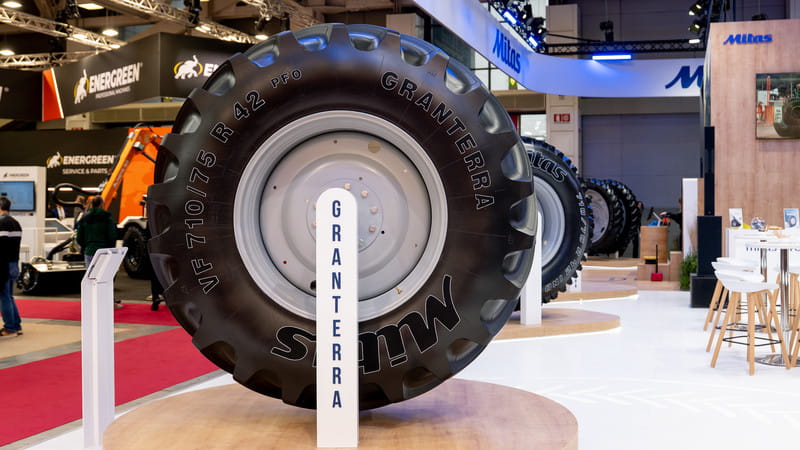
That was the story Mitas told in Hall 14, Stand B2, with four ranges matched to four big themes of the show.
- More power: GRANTERRA. Built for high-horsepower tractors, with VF PFO technology for high-torque, low-speed fieldwork between 5 and 15 km/h. Lower inflation pressure means a bigger footprint and efficient power transfer. In a recent Yokohama TWS benchmarking test, GRANTERRA came out as the best-performing tire against competitor products in the same sizes, as we covered in our latest article here on our blog.
- More transport: AGRITERRA ULTRA. For farms that switch between loaded road runs and field work, load capacity, stability and a 65 km/h speed rating matter as much as engine power.
- More versatility: HCM. For tractors that move between roads, green areas and farmland, with comfort, durability and versatility for machines that rarely spend their whole life on one job.
- More precision: AC 85 Row Crop. Shown in a dual-mounted configuration, it brings precision down to row width. Guidance keeps the machine on its line. The tire still has to fit between the crops.
Your EIMA homework
Don't try to apply every trend at once. Pick one job you want to do better: pulling a drill on damp ground, hauling a full trailer, spraying between rows or working with a high-power tractor.
Then write down three things:
- The real axle loads with the machinery set up for that job.
- Your working speeds in the field and on the road.
- The one result you want: less slip, a smoother ride, more crop clearance or fewer trips.
Bring those numbers to your next demo or to your Mitas dealer. They will tell you far more than horsepower alone, and give you a practical starting point for choosing the right tire and inflation pressure for the work.
See you in Bologna from 14 to 18 November 2028. Until then, the best technology is the one that makes your next pass better.
Show figures: FederUnacoma, EIMA International 2026 closing data. Market data: FederUnacoma. Tire test: Yokohama TWS internal benchmarking test, 2026.