

How tyre casings affect performance
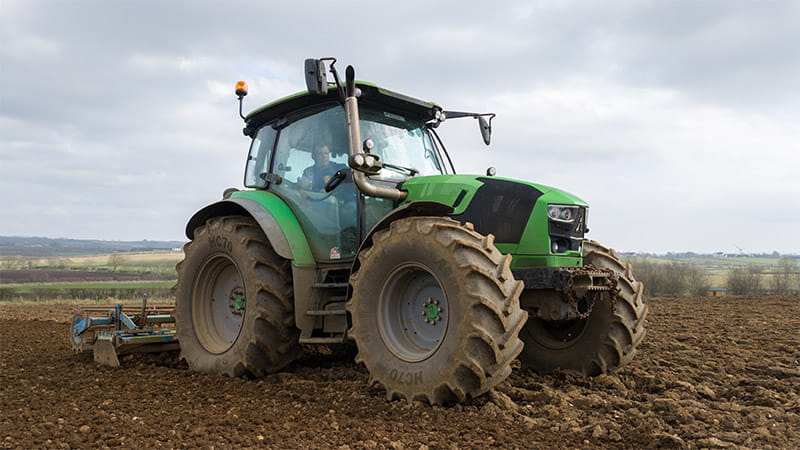
The structural core of the tyre
A tyre's main characteristics are largely determined by its casing. In particular, the casing influences:
- Flexibility
- Load capacity
- Comfort and stability
- Ground contact area
In recent years, agricultural machinery has become increasingly powerful, larger and heavier. A casing that allows the tyre to operate at low inflation pressures is essential for limiting soil compaction and preserving soil fertility.
The two main types of tyre casing
Bias-ply construction has historically been the most widely used solution. The plies are layered and crossed, creating a highly compact structure with excellent resistance to impacts. This gives the tyre excellent mechanical strength, high load capacity and good impact resistance.
On the other hand, this construction is less flexible. As a result, it provides a smaller contact area, causes greater soil compaction and offers reduced traction, particularly in demanding conditions such as uneven terrain or soils that are excessively wet or dry.
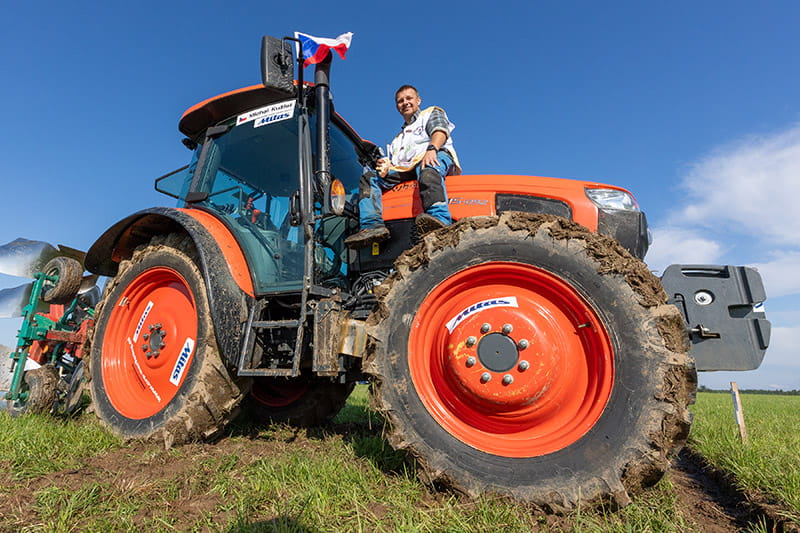
The Mitas TD-19 is an example of a bias-ply tyre developed for low- and medium-horsepower tractors. Its R-1 tread pattern delivers excellent traction even on uneven terrain while ensuring good stability on all types of surfaces. The robust casing provides excellent wear resistance and long-term reliability, making the TD-19 a versatile solution suitable for every type of tractor and operation.
However, a rigid tyre such as one with a bias-ply casing is not always the best solution. In agriculture, tyres must be optimised primarily for field work, where operating conditions are very different from those encountered on the road.
A more flexible product is needed, capable of adapting to a wide range of conditions, from uneven agricultural fields to country roads and paved roads. This is why bias-ply construction has gradually given way to radial construction, which is now the most widely adopted solution in agriculture.
In a radial tyre, the plies run radially from bead to bead, perpendicular to the direction of travel, while steel belts or high-strength textile reinforcements stabilise the tread.
This construction is particularly well suited to agricultural applications. The tyre becomes much more flexible, adapting more effectively to uneven ground while transferring the weight and power of agricultural machinery more efficiently to the soil. The larger footprint helps limit soil compaction, preserve soil fertility, maintain soil structure and drainage capacity, while at the same time improving traction by providing a larger contact area.
In summary, bias-ply and radial tyres differ in several key aspects:
- Ply orientation: in bias-ply tyres, the plies are arranged at crossed angles (30–40°) to the direction of travel, whereas in radial tyres they run perpendicular to the direction of travel.
- Inflation pressure: bias-ply tyres require higher inflation pressures to support both the load and the tyre structure, whereas radial tyres can operate at lower pressures, delivering all the associated agronomic and operational benefits.
- Traction: because radial tyres can operate at lower inflation pressures, they provide a larger contact area and therefore greater ground grip.
- Soil compaction: radial tyres distribute the machine's weight over a larger surface area thanks to their ability to operate at lower inflation pressures, helping to limit soil compaction.
- Service life: bias-ply tyres experience greater wear and generate more heat during operation, meaning radial tyres generally offer a longer service life.
- Load capacity: radial tyres provide greater load capacity, also thanks to VF (Very High Flexion) technology, which allows them to carry up to 40% more load than a standard tyre.
- Impact resistance: bias-ply tyres have stronger sidewalls, making them more resistant to impacts, cuts and damage.
In practice, distinguishing a radial tyre from a bias-ply tyre is straightforward: simply check the markings on the sidewall. Radial tyres feature the letter "R" before the rim diameter, for example 600/65R28. Bias-ply tyres do not include the letter "R", or instead display a hyphen. In some cases, the letter "D" is used in place of "R".
The importance of materials
The objective of radial tyre casings is to achieve the right balance between strength and flexibility, providing high load capacity without sacrificing the flexibility that is essential for soil health, field performance and tyre self-cleaning.
To achieve this, the choice of materials used in the casing is both fundamental and strategic.
Mitas SFT (Super Flexion Tyre) tyres are an excellent example of radial tyres, developed for high-horsepower tractors. Their flexible and highly durable sidewalls allow them to operate at low inflation pressures while maintaining high load capacity and protecting the soil.
In addition, their generously sized tread lugs provide excellent traction even in the most demanding field conditions.
Greater soil fertility, better performance
The casing is the internal framework of the tyre and the component that determines its characteristics.
Choosing a tyre with an advanced casing does not mean increasing costs. On the contrary, it means improving the productivity of the soil, agricultural machinery and, consequently, farm profitability.