

The concept of “Controlled Traffic Farming” for more soil-friendly agriculture
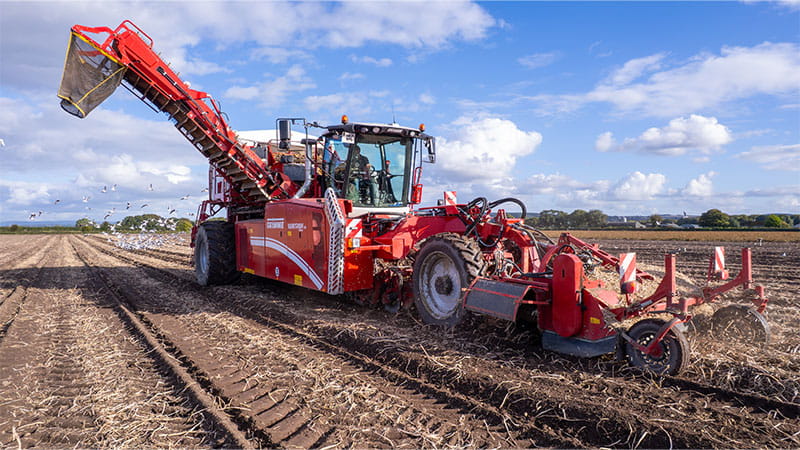
The underlying reason: the phenomenon of soil compaction
The continuous passage of heavy machinery on agricultural land inevitably causes soil compaction to a greater or lesser extent: a compacted soil experiences a significant reduction in its porosity. This leads to reduced water drainage, risk of root asphyxia, surface or subsurface water stagnation, and, in general, a drastic decrease in fertility. You can consult the article on our blog in which we analyze this phenomenon in detail, its causes and agronomic effects.
The solution: Controlled Traffic Farming
Among the best techniques to reduce soil compaction is controlled traffic. Contrary to what one might think, this technique does not involve trying to step on the soil in a homogeneous way in order not to compact it too much in absolute terms but involves stepping only and exclusively on certain lanes in the field, so that everything else remains untouched. In an efficient and well-organized controlled traffic system, it is estimated that less than 20% of the soil is trafficked¹. This system increases its effectiveness as the working width of agricultural equipment increases, as this would lead to fewer passes and therefore fewer lanes and therefore a lower percentage of compacted soil. In these systems, guidance technologies and precision agriculture play a fundamental role as they allow the farmer to return to the same lanes year after year.
The role of tires
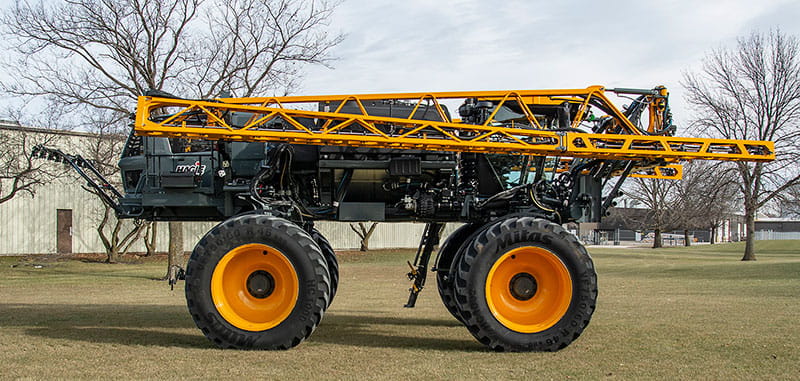
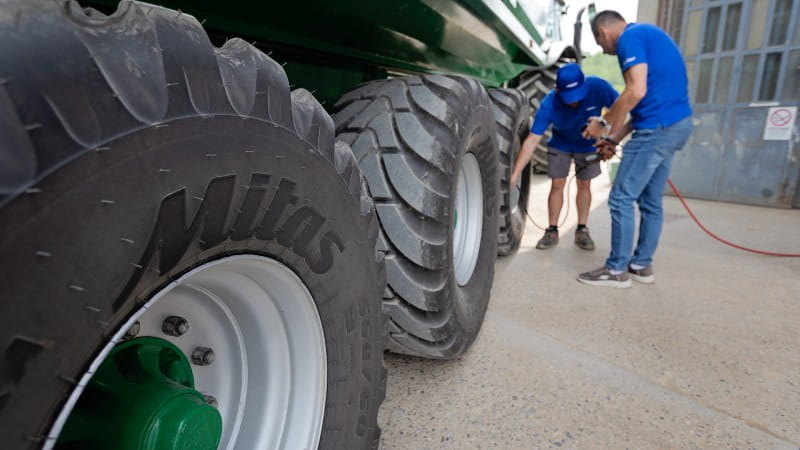
If on the one hand in a well-organized controlled traffic system, more than 80% of the soil is never trafficked, on the other hand there is still 20% that continuously undergoes marked compaction¹. From here comes the importance of having tires capable of limiting this phenomenon. The solution developed by Mitas for this activity and, above all, capable of meeting the growing need to reduce soil compaction is the HC1000, a narrow tire for self-propelled sprayers and, more generally, for row crop applications.
Thanks to its VF (Very High Flexion) technology, the HC1000 can support loads 40% higher than a standard tire, or, following the opposite reasoning, it can support the same load with 40% lower pressure, increasing the footprint and reducing compaction. In addition, the higher number of lugs compared to a standard tire and the exclusive Hexa-Core technology offer greater durability and lower wear. The individual wires are bent and fixed in a hexagonal shape, making the tire bead resistant and ensuring high torque transmission.
Discover all the features of the Mitas HC1000 on our website.
¹Source: M. Benetti – “Traffico controllato ancora troppo poco conosciuto”. L’Informatore Agrario n. 6/2025,
https://www.informatoreagrario.it/meccanica/traffico-controllato-ancora-poco-diffuso-in-italia/