

Tire pressure and soil compaction in summer: what nobody tells you
Late August is when some farms already start looking ahead for the upcoming winter while others are still in full swing. Late barley and wheat harvest goes along with early varieties of apples and pears. While silage is still moving, sugar beet and maize campaigns are taking shape, grape picking is about to start.
In such busy weeks, tire pressure is not just a setup detail. On the contrary, proper inflation is one of the factors that decides whether this season’s heaviest passes protect the soil or damage it, and whether machinery keeps performing at its best when it matters most.
Why the season raises the stakes
Clay and loam soils may seem solid on the surface after a long summer, but the structure below has already weakened. Drying can cause shrinkage, surface hardening, and cracking. When rainfall or moisture returns to dry ground, the soil profile can become more vulnerable to deformation under heavy loads. This is exactly the moment when farming machinery and implements can quickly cause compaction damage if they enter the field before conditions are right. Late-harvest crops such as maize, sugar beet, and potatoes are especially vulnerable, needing an open, well-aerated soil structure for root growth and water uptake. This is exactly why what happens at the tire’s contact patch starts to matter so much this time of year.
The tire-soil interplay: why pressure matters
Agricultural tires form the interface between machinery and soil. They turn power into motion, transmit traction, and support the weight of equipment and loads. At the same time, they influence how that weight is passed into the ground. In that sense, the tire does not “cause” compaction on its own; it rather influences the way the stress is applied to the soil.
That is why inflation pressure matters so much. Tire pressure determines the shape of the footprint, and the footprint determines how the weight is distributed. At higher pressure values, the smaller contact patch concentrates the force on less ground. Lowering the pressure to the correct field setting does the opposite: on a larger contact area weight is spread more evenly, and the risk of compaction falls.
Managed this way, tire pressure becomes a field condition to set for the day’s work, not a fixed number left over from the last check. Get it right, and the soil is protected without asking the equipment to carry any less than it needs to, whether it is about to head into the field or back onto the road.
Field pressure vs. road pressure and other important factors
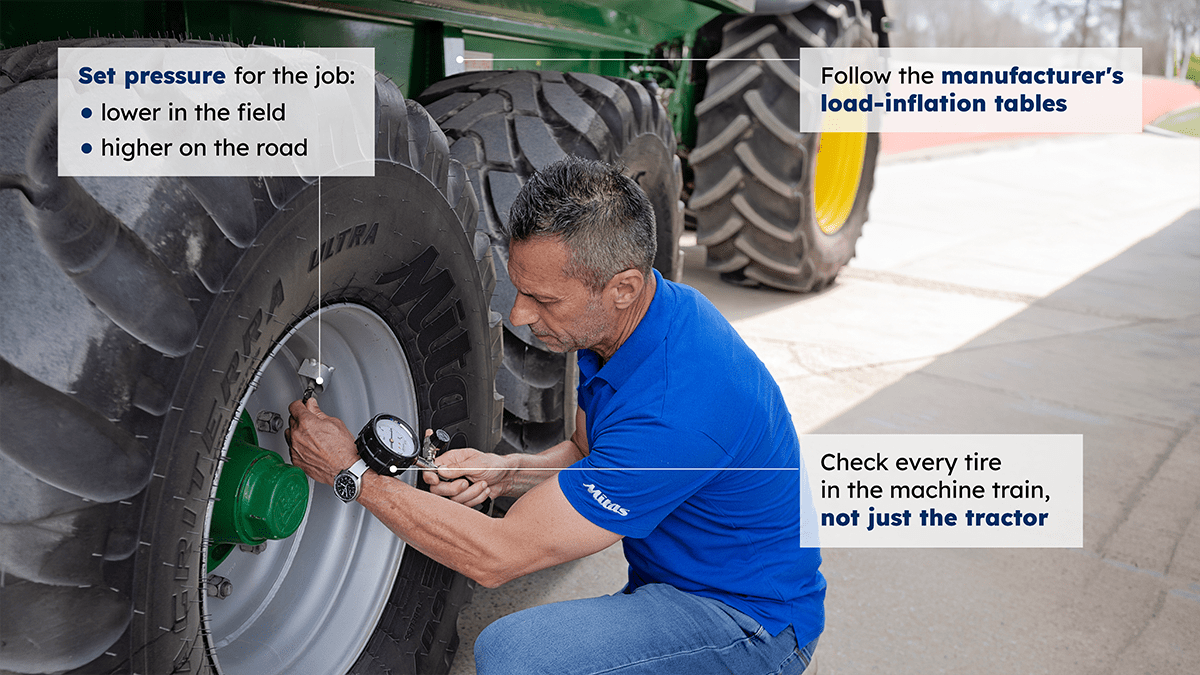
As we covered in our article on agricultural tire inflation pressure, field and road conditions demand different setups: lower pressure in the field to protect the soil, higher pressure on the road to support speed and stability.
The same logic applies to the entire machine train. Even if the inflation of your tractor tires has been adjusted correctly, the heaviest loads are often carried by trailers, tankers, and implements. The soil does not care which axle caused the damage. If just one element in the operating chain is underinflated or overinflated, it can reduce the benefit of all other well-set tires.
Treated this way, pressure stops being a compromise setting split between road travel and harvest work and becomes simply part of the field operation itself, checked and adjusted like any other pass across the field, which is also where tire technology starts to make the job easier.
What VF tires can do
Very High Flexion (VF) tires can carry higher loads at a lower inflation pressure than a standard radial of the same size. VF tires can carry around 40 percent more load at the same pressure as a standard tire; alternatively, the same benefit can be used to run lower field pressure for the same load.
VF technology fits naturally into this picture. It does not replace good pressure management, but it gives the operator more room to work with when the goal is to protect soil structure without giving up load-carrying capacity. In other words, VF helps the tire do its job more efficiently in the field, while pressure still has to be set correctly for the load, speed, and application.
Mitas has followed this direction across its agricultural range, from tractor tires such as the GRANTERRA to implement such as the TERRAGUARD, both designed to carry higher axle loads at lower inflation pressure while helping distribute weight over a larger contact area to limit soil compaction.
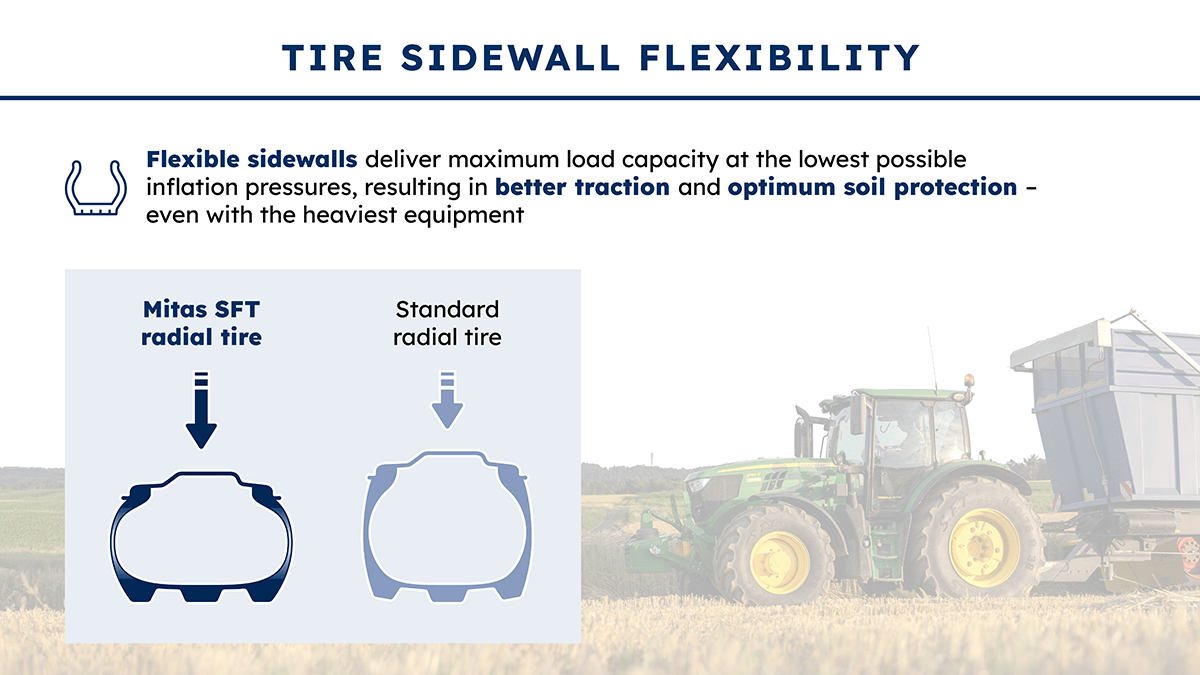
For high-horsepower tractors and harvesters, Mitas applies the same principle through the SFT range. An extra-large air volume and ultra-flexible sidewalls keep inflation pressure low even under the heaviest loads, protecting the soil without asking these larger machines to compromise on performance.
The right time to act is now
The season leaves little room for mistakes, but the response comes down to a few habits: setting tire pressure for field conditions rather than road travel, checking every tire in the machine train and not just the tractor, and choosing technology that allows lower pressure without sacrificing load capacity. None of it is complicated, but it matters most before compaction occurs, not after.
Talk to your Mitas dealer to review the right pressure and tire choice for your fleet or use the Mitas tire pressure calculator to check your current setup before the next pass.