

Track or tires? Which is the best solution for your needs?
Use and advantages of tracks
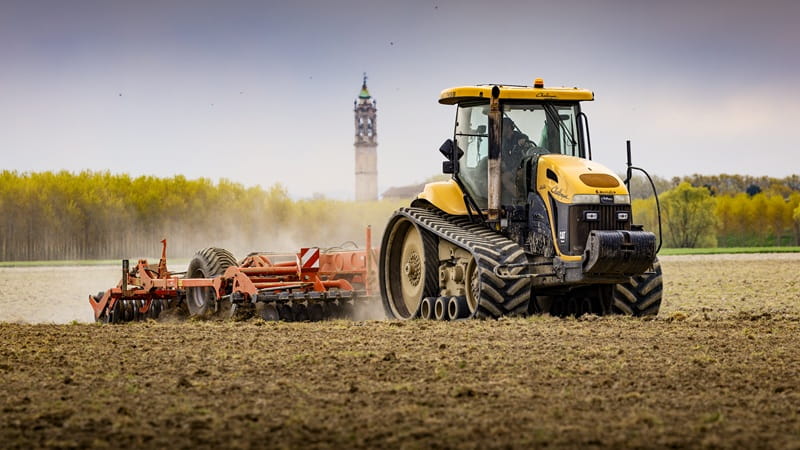
From both an agronomic and performance standpoint, the main strength of tracks is the ability to distribute the weight of the agricultural machine over a larger surface compared to traditional tires: this leads to numerous advantages.
With a larger contact area, ground pressure is lower, significantly reducing compaction and benefiting soil fertility.
A larger contact surface also means greater traction, allowing the agricultural machine to exert higher pulling power, improve productivity, and operate even when conditions are not optimal. An example is rice harvesting, where all combine harvesters are equipped with front tracks to allow better mobility in the field.
Operators also benefit from improved comfort in the field: by increasing the contact area on the ground, the various shocks and oscillations reaching the cab are reduced, especially on less even terrain such as after tillage.
Another factor to consider is tractor slippage: the higher it is, the lower the pulling capacity and consequently the working capacity of the tractor (in terms of hectares worked per unit of time). ¹This is backed by research published in the Journal of Agricultural Engineering, which compared the working capacity of two tractors with the same engine, weight, size, and transmission during ploughing at different depths, with the difference that one tractor was equipped with four tires and the other with four tracks. The results are clear: the tracked tractor showed a theoretical working capacity from 15% to 25% higher than its wheeled counterpart. Fuel consumption is also in favor of the tracked tractor, which saved 20% compared to the wheeled tractor, a saving due both to the greater working capacity and to lower slippage. Finally, the advantages are also economic. ²According to a study coordinated by Professor G. Canali of the Catholic University of Piacenza and conducted on a farm cultivating 260 hectares (of which 110 double-cropped), the use of a tracked machinery fleet led to savings of over 350 working hours per year (from 1,051 to 682).
Use and advantages of tires
The use of tracks offers many advantages; however, in most scenarios, tires are by far the preferred driving solutions among farmers.
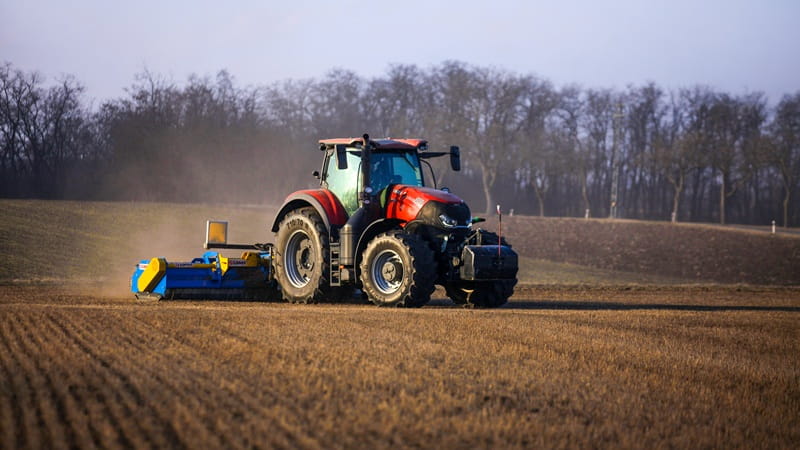
The first major strength of wheeled tractors is certainly their operational versatility. A wheeled tractor is well suited to a wide range of tasks, across different working speeds and power requirements.
In many farms, there are multipurpose tractors that, over the course of a single day, can be used for very different tasks, some of which would be difficult if carried out with a tracked tractor (for example, work inside livestock buildings, feed mixing and distribution, or handling pallets). In this context, the agility of a wheeled tractor is unmatched.
Another key advantage lies in operating costs. Tire maintenance and, when necessary, replacement, is a relatively simple task that can be performed by most operators, provided the right tools are available. This helps minimize downtime, even during the busiest periods when workload is at its peak.
It’s also important to consider the versatility of certain tires that enable adjustable inflation pressure: lower pressure in the field enhances traction and helps limit soil compaction, while higher pressure on the road reduces rolling resistance and, in turn, fuel consumption.
The latest Mitas rubber track solution: MITRAK
Depending on specific needs, each farmer may prefer tires or tracks for each tractor in the fleet, according to the tasks it is intended for.
Aware of the importance of both options, Mitas has expanded its range by introducing MITRAK, the new Mitas range of agricultural rubber tracks. The special tread compound, designed to increase resistance to wear and cuts, ensures high durability even in the most demanding conditions. The track body is reinforced to maximize performance and stability, evenly distributing stresses and ensuring smooth operation.
Brass-coated galvanized steel cables provide uniform resistance along the track, supporting heavy loads and extending the track’s lifespan. An additional protective layer shields the cables from drive wheel abrasion, ensuring reduced wear over time.
MITRAK is designed for any tracked agricultural machine, offering a high-performance product capable of delivering excellent results while ensuring low ground pressure and optimized flotation, reducing soil compaction.
Mitas once again confirms its leadership in the sector, offering a wide range of solutions suitable for any type of agricultural machine, regardless of power, application, or machinery type.
With MITRAK, the range becomes even broader: whether you choose tracks or tires for your machines, Mitas is always able to provide high-quality products to maximize the efficiency and performance of your machinery fleet.
Discover the new Mitas MITRAK track and all its features on our website.
¹Source: G. Molari et al. - “Field performance of an agricultural tractor fitted with rubber tracks on a low trafficable soil” - Journal of Agricultural Engineering
²Source: O. Repetti - “Contro il compattamento del suolo metti i nastri al tuo trattore” - Terra e Vita – Edagricole. Article