

Why is tire self-cleaning so important and how can be improved?
The importance of this feature for tires
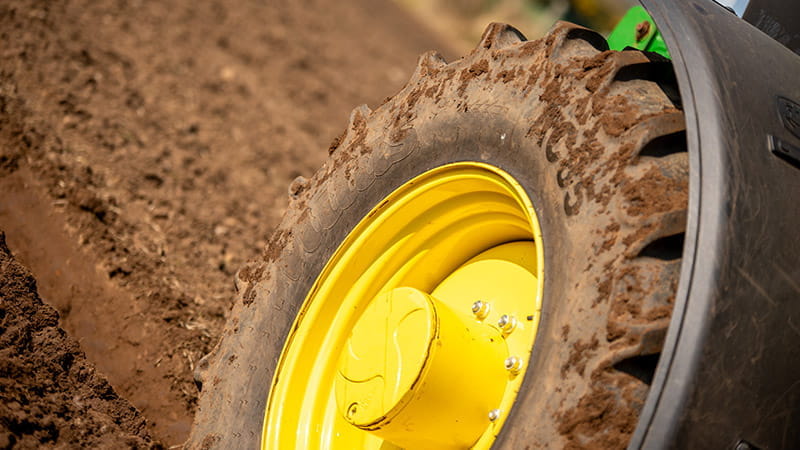
Good self-cleaning capability is essential for any agricultural machine, regardless of the type of equipment on which the tire is installed. The benefits can be seen both during field operations and while driving on the road:
- In the field, effective self-cleaning allows the tread design to perform at its full potential by keeping the lugs free from soil and mud. This results in better grip on the ground and therefore improved traction capability. Reduced slippage also leads to lower fuel consumption and greater operational efficiency, aspects that are becoming increasingly important in farm cost management
- On the road, proper expulsion of residues prevents soil and mud from being carried outside the fields. In addition to improving road cleanliness, this helps increase traffic safety, especially for motorcycles and two-wheeled vehicles. In many countries, road contamination caused by agricultural machinery can also result in financial penalties
But how does it work?
Self-cleaning can be seen as a cyclical sequence of actions repeated with every rotation of the tire around its axis:
- The part of the tire in contact with the ground deforms and collects soil inside the empty spaces created by the tread lugs
- The section that was previously in contact with the ground lifts as the tire rotates
- As it rises, it undergoes deformation in order to return the tire to its original shape
- This flexing action allows the soil trapped inside the tread to be expelled
3 useful tips to improve agricultural tire self-cleaning
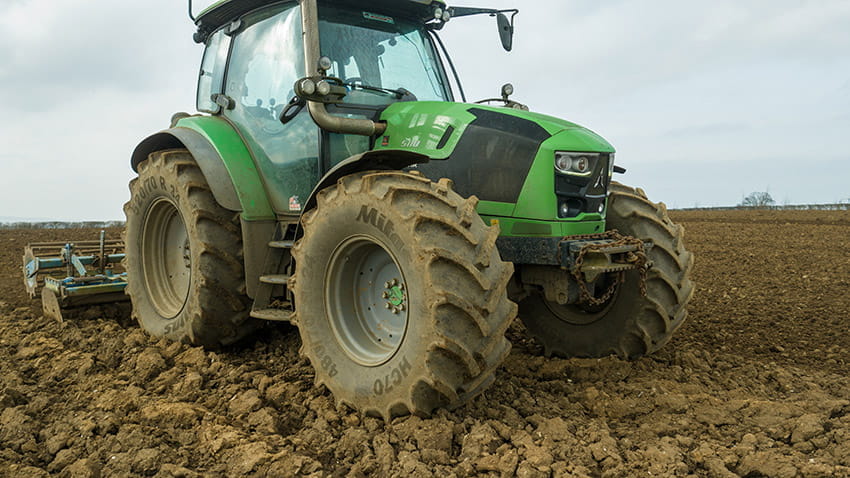
By understanding how self-cleaning works, it becomes clear that tire flexibility plays a key role in the ability to expel soil and residues from the tread.
However, there are also other factors that can improve this phenomenon:
- Inflation pressure is one of the main factors affecting tire self-cleaning performance. The higher the pressure, the lower the flexibility of the carcass, which therefore tends to deform less during rotation. Reduced deformation limits the natural expulsion of soil and residues from the lugs. For this reason, it is important to enter the field with tires designed to operate at low inflation pressures, helping to increase the tire footprint, improve traction, and enhance self-cleaning performance
- Tread pattern design is another determining factor that can be optimized to improve self-cleaning. The classic “herringbone” lug pattern, for example, promotes the lateral movement of soil thanks to the centrifugal force generated by tire rotation, facilitating residue expulsion. The effectiveness of this process increases as the spacing between the lugs becomes wider and decreases when the lugs are positioned closer together. This is why tractor tires generally feature more pronounced self-cleaning capability than trailer tires, which are characterized by shallower and more compact tread blocks
- Monitoring wheel slip and soil conditions also play a fundamental role in optimizing self-cleaning capability. Excessive slippage tends to compact the soil between the lugs instead of expelling it, progressively reducing the tire’s ability to “clean itself” during operation. Likewise, working on heavily water-saturated or highly clayey soils increases the risk of tread clogging. Monitoring tractor slippage and avoiding field operations in extremely saturated soil conditions, whenever possible, therefore helps preserve traction, operational efficiency, and tire self-cleaning performance
Self-cleaning and soil protection: the GRANTERRA solution
Every agricultural tire is designed to maximize self-cleaning capability, improving both field productivity and road cleanliness during transport operations.
To achieve this objective, Mitas invests hundreds of hours in research and development with the aim of continuously refining its technological solutions.
One concrete example is the brand new GRANTERRA, designed for high-power tractors.
The innovative tread pattern not only improves stability and traction, but also provides excellent self-cleaning performance, thanks to the raised area between the lugs.
This tire is manufactured using VF (Very High Flexion) and PFO (Pressure Field Operation) technologies, which allow operation at lower inflation pressures without compromising load capacity, and enhancing self-cleaning performance.
You can find all the product’s technical specifications on our website at the following link.
Higher performance and greater road safety
Self-cleaning capability is a crucial factor when choosing tires for agricultural machinery. Traction capability, operational performance, and therefore profitability can all depend on it. Now that you know which factors influence this phenomenon, you will be able to evaluate the most suitable solution for your operational needs.